The Wealth Flywheel: How to Make Money, Get Your Money Back, and Let It Keep Making More
Why I would rather own a little of a hundred businesses than work my entire life to own one.
I don’t need a private jet.
Don’t get me wrong. I’m not opposed to flying private. I’m sure it’s wonderful. But when I consider the economics, flying Delta One and keeping millions of dollars invested sounds like a pretty good trade.
That’s something I’ve come to appreciate more as I’ve gotten older and accumulated more wealth.
The goal was never really to have the biggest house, the nicest car, or the most expensive lifestyle. It was to have the freedom to decide what my life looks like without money making those decisions for me.
And I’ve learned something interesting along the way.
Building wealth and living a rich life are two very different things.
You can be extraordinarily wealthy and still feel poor if your expectations grow faster than your bank account.
Conversely, you can have far less than you ever imagined needing and still live an incredibly rich life.
The trick is defining what enough looks like before you get there.
Because if you never define enough, enough will always be somewhere else.
1. The Rule of 72: Why Time Is More Powerful Than Money
One of my favorite financial concepts is something called the Rule of 72.
It’s extraordinarily simple, but once you understand it, you begin looking at money differently.
Take the number 72 and divide it by your annual rate of return. The answer tells you approximately how many years it takes your money to double.
Let’s say you have $100,000 invested and earn an average compounded return of 8% annually.
72 ÷ 8 = 9.
Your money doubles approximately every nine years.
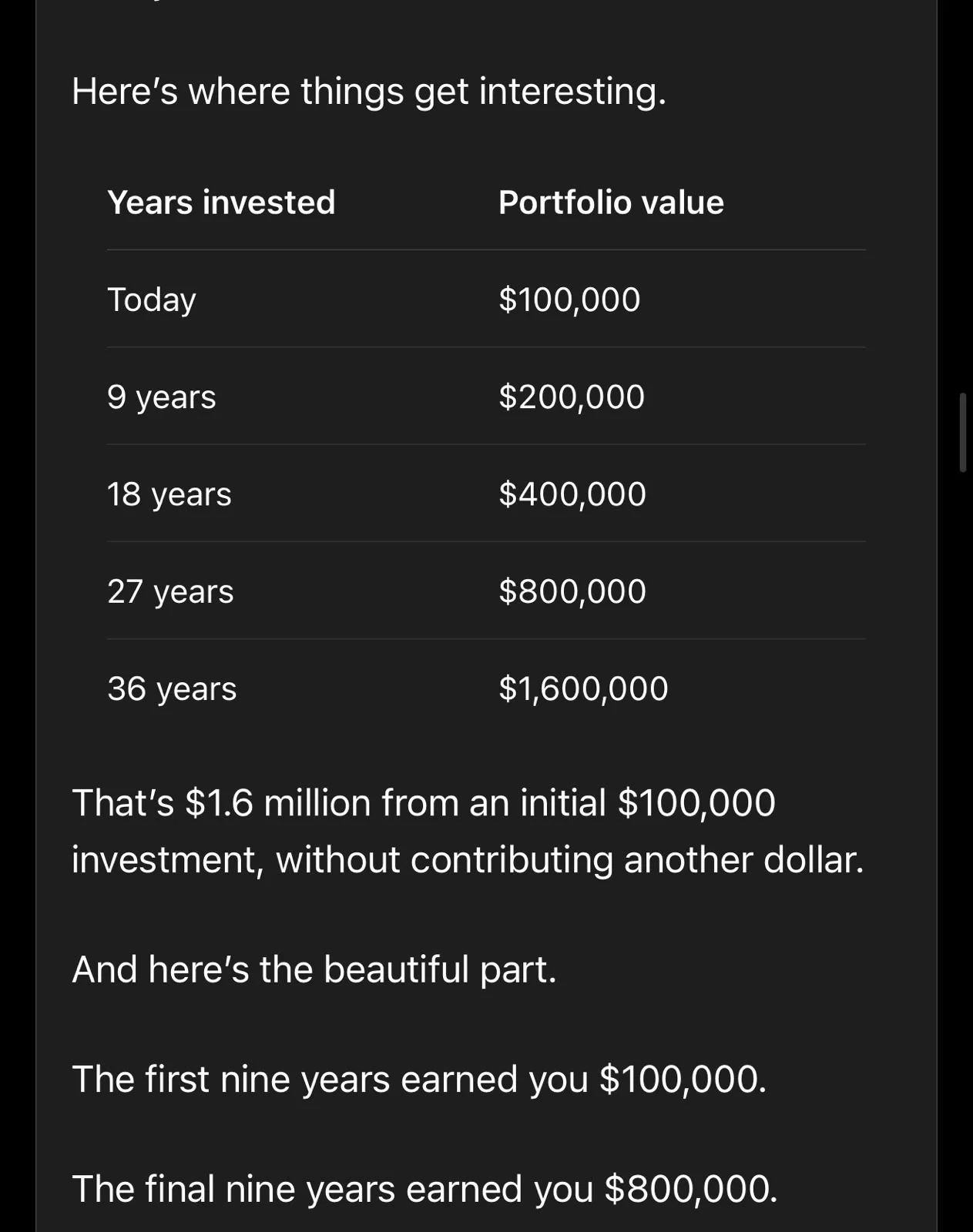
Here’s where things get interesting.
Years invested Portfolio value
Today $100,000
9 years $200,000
18 years $400,000
27 years $800,000
36 years $1,600,000
That’s $1.6 million from an initial $100,000 investment, without contributing another dollar.
And here’s the beautiful part.
The first nine years earned you $100,000.
The final nine years earned you $800,000.
Same money. Same assumed return. Same amount of time.
Eight times the dollar growth.
That’s the extraordinary mathematics of compounding.
Of course, an 8% return is an illustration, not a guarantee. Actual investment returns fluctuate, and taxes, fees, and inflation affect what that future money can buy.
But the underlying principle remains.
The longer your money works, the more valuable each additional year becomes.
Now imagine starting with $1 million instead of $100,000.
Or $5 million. Or $10 million.
The mathematics don’t change, but the magnitude certainly does.
At some point, your existing capital can potentially generate more annual wealth than you’re capable of earning through your own labor.
And that’s when something remarkable happens.
Your money begins doing more of the working while you begin doing more of the living.
2. Infinite Returns: My Favorite Way to Invest
There’s another investment concept I love.
I call it an infinite return.
The idea is simple: Invest money into something that produces income, recover your original investment, and continue owning an asset that generates cash flow.
Let me explain.
Imagine I invest $500,000 into a business.
Perhaps it’s an HVAC company, a diesel mechanic shop, or another business that needs capital to expand.
Over the next three years, the business generates enough cash to return my original $500,000 through an agreed repayment or capital return structure.
Now I have my original money back.
But here’s the important part.
I still own equity in the company.
And that company might continue paying me $2,000, $5,000, or $10,000 every month.
How much of my original capital remains unrecovered?
Zero.
And what’s my ongoing cash return relative to that unrecovered capital?
Mathematically, you can’t calculate a conventional percentage return using a zero denominator. But conceptually, that’s why I call it an infinite return.
My original investment is back in my hands, but the asset I acquired is still working for me.
To be clear, the profits aren’t literally infinite, and the equity isn’t risk free. Businesses can fail, distributions can stop, and returning invested capital doesn’t eliminate all economic risk.
But from a capital efficiency standpoint, it’s an incredibly attractive arrangement.
Because I can take that same $500,000 and do it again.
And again.
And again.
One pool of capital can create multiple streams of income over time.
That’s the real magic.
Not an infinite amount of money.
An investment that can keep producing value after the original capital has been recovered and redeployed.
3. Why I’d Rather Own a Little of a Lot
I’ve never been particularly interested in owning 100% of every business I invest in.
In fact, I generally prefer owning a minority stake.
Sometimes that’s 10%. Sometimes 20%.
The exact percentage depends on the opportunity, the capital required, the risks, and the value I can bring to the business.
But the philosophy is consistent.
I’d rather own a smaller piece of several well-run businesses than spend every waking hour operating one.
For example, I’ve invested in companies involved in HVAC, diesel repair, healthcare staffing, and gold and silver minting, among other things.
Not exactly the glamorous businesses people imagine when they think about entrepreneurial success.
No flashy tech startups.
No billion-dollar valuations.
Just real businesses providing real products and services to real customers.
And I love that.
One of my favorite investments involved a diesel mechanic repair business.
The operators didn’t need millions of dollars. They needed approximately $300,000 to get the right equipment, secure a location, purchase lifts, and get things moving.
That capital helped unlock an opportunity.
Roughly a year and a half later, the business was generating meaningful profits.
My job wasn’t to repair diesel engines.
Trust me, nobody wants that.
My job was to help the people who knew how to repair diesel engines get the resources and relationships they needed to build a successful company.
That’s an important distinction.
You don’t have to be the person doing the work to be the person helping make the work possible.
Sometimes capital is what a business needs.
Sometimes it’s connections.
Sometimes it’s experience, mentorship, strategy, or simply having somebody available to help solve a difficult problem.
I’ve discovered that my network and experience can be just as valuable as the money I contribute.
When all of those things come together, everybody has an opportunity to win.
The founders retain most of their ownership.
The company gets the resources it needs.
And I get a minority interest in something that can grow without requiring me to become its full-time operator.
4. The Power of a Hundred Small Streams
Here’s a thought experiment I love.
Imagine owning minority stakes in a hundred companies.
And imagine each of those companies eventually distributing $10,000 to you every month.
That’s $1 million a month.
Now, I’m not suggesting building a portfolio of a hundred successful companies is easy or that those distributions are guaranteed.
Quite the opposite.
Finding good operators, negotiating fair terms, avoiding bad investments, and supporting businesses through difficult times takes considerable work.
But the illustration reveals something important.
You don’t necessarily need one enormous business to create enormous wealth.
You can build wealth through many smaller ownership interests.
And there’s something else I love about this arrangement.
You don’t have to be the hero of every story.
I don’t need to run the HVAC company.
I don’t need to manage the diesel shop.
I don’t need to oversee every aspect of a healthcare staffing business.
There are talented people who are much better at those things than I am.
My role is to help them succeed.
I still take calls. I attend meetings. I answer texts. I help solve problems. Sometimes I provide additional capital or introduce someone who can open a door.
But my involvement is different from operating a company every day.
I’m working on the businesses, not necessarily in them.
And importantly, I enjoy it.
I enjoy watching people succeed.
I enjoy seeing a small business become something meaningful.
I enjoy helping somebody accomplish something they might not otherwise have been able to accomplish.
That’s a much more fulfilling use of my time than trying to do everything myself.
5. Why Opportunities Seem to Find Me
People sometimes ask me how I find these investments.
And my answer usually surprises them.
I talk about them.
That’s it.
Well, that’s not entirely it, but it’s a much bigger part of the equation than people realize.
I talk about business. I talk about investing. I talk about interesting opportunities. I talk about ways to help companies grow.
And because those are the conversations I have, people begin associating me with those opportunities.
Somebody has a friend trying to expand an HVAC business.
Somebody knows a business owner who needs capital.
Somebody has a partnership opportunity but doesn’t know who to approach.
Eventually, those people think of me.
And opportunities begin showing up.
There’s a psychological component to this as well.
You’ve probably experienced something called the frequency illusion.
Imagine you decide you want a blue BMW.
Suddenly, you start seeing blue BMWs everywhere.
At intersections.
In parking lots.
On the freeway.
You might think everybody suddenly bought the same car.
But that’s not necessarily what happened.
The cars were already there.
Your attention changed.
Your brain constantly filters an overwhelming amount of information. Systems involving attention and alertness, including the reticular activating system, help determine what receives conscious attention.
The frequency illusion also involves selective attention and how we remember newly relevant things. It isn’t simply the work of one brain structure.
But the practical lesson is powerful.
Once something becomes important to you, you’re more likely to notice it.
And I’ve found this particularly useful in business.
When you’re consistently thinking about opportunities, you begin recognizing problems you can solve, connections you can make, and investments that might otherwise have passed you by.
But there’s an important second half.
You also have to tell people what you’re looking for.
Attention helps you recognize opportunities.
Relationships help bring opportunities to you.
And action is what converts those opportunities into actual results.
There’s nothing mystical about it.
It’s the intersection of focus, relationships, reputation, and execution.
What you focus on shapes what you notice. What you talk about shapes what people bring you. What you act on shapes what you become.
6. The Wealth Flywheel
When I look at how I’ve approached investing over the years, I realize the individual strategies are really parts of one larger system.
I call it my wealth flywheel.
Here’s how it works.
First, I earn money through businesses or other active opportunities.
Then I invest that money into assets capable of generating income or appreciating over time.
When I invest directly in a business, I try to structure the arrangement so that I can recover my original capital while retaining an ownership interest.
That doesn’t always happen, and it certainly isn’t appropriate for every transaction. But when the economics and the partnership support it, it’s a priority.
Once capital is returned, I can put it to work somewhere else.
Meanwhile, the original business may continue producing distributions.
As I help additional businesses grow, my network expands. My experience grows. My reputation becomes more established.
And more opportunities find their way to me.
So the process begins feeding itself.
Capital creates ownership.
Ownership creates potential cash flow.
Recovered capital creates additional ownership.
Experience creates better judgment.
Relationships create more opportunities.
And time allows those advantages to compound.
That’s the flywheel.
Each successful rotation can make the next one easier.
Of course, diversification doesn’t eliminate business risk, and a collection of minority stakes can be illiquid, difficult to value, and challenging to oversee.
The system only works if the underlying businesses are healthy, the arrangements are fair, and the money is managed responsibly.
But when it works, the results can become increasingly powerful.
You’re no longer relying exclusively on the number of hours you’re willing to work.
You’re building a collection of assets, relationships, and opportunities that can continue creating value whether you’re working that afternoon or spending it with your family.
7. But What’s the Point of All This Money?
This is where I think a lot of people get lost.
They become so good at making money that they forget why they wanted it in the first place.
Their lifestyle expands.
Their expectations expand.
Their obligations expand.
And suddenly they’re making ten times what they used to make, but they don’t necessarily have ten times the freedom.
Sometimes they have less.
That’s why I think defining your rich life matters so much.
What does enough look like?
Is it flying first class whenever you travel?
Is it spending more time with your children?
Is it having the freedom to turn down opportunities that don’t excite you?
Is it being able to help somebody you love without worrying about the financial consequences?
Is it having a beautiful home, traveling the world, or simply never feeling financially obligated to work again?
There’s no universal answer.
That’s the point.
You have to define it for yourself.
For me, it’s not about owning a private jet.
It’s about being able to travel when I want, spend time with my family, pursue interesting opportunities, and enjoy the experiences that make life meaningful.
I still love business.
I still love investments.
I still love watching the numbers grow.
But I don’t want to sacrifice the life I’m trying to build just to make those numbers a little bigger.
At some point, the purpose of wealth should be to make your life richer, not simply your balance sheet larger.
And the fascinating thing about compounding is that you may not need to choose between enjoying your life and continuing to grow your wealth.
With sufficient assets, responsible spending, and a disciplined investment strategy, both can coexist.
Your money can keep working even when you don’t.
8. The Ultimate Return on Investment
I’ve spent a lot of my life thinking about returns.
Returns on capital.
Returns on businesses.
Returns on real estate.
Returns on investments.
But as I’ve gotten older, I’ve become increasingly interested in another kind of return.
The return on my time.
Because unlike money, time doesn’t compound.
You can’t earn back an afternoon with your children.
You can’t invest your way into another year of being young.
And you can’t put off living indefinitely while waiting for the magical day when you finally have enough.
That’s why I think the real objective of building wealth is much bigger than becoming wealthy.
It’s creating the freedom to live deliberately.
It’s getting to a place where you work because you want to, not because you have to.
Where you can help build companies without having to run every one of them.
Where you’re no longer trading every hour of your life for another dollar.
And where you can decide what matters most, then spend your time accordingly.
The Rule of 72 taught me how money compounds.
Investing in businesses taught me how capital can be recycled.
Minority ownership taught me how to leverage the talents of other people.
And focusing on opportunities taught me how attention and relationships can change what’s possible.
But perhaps the most important lesson is this:
There’s no point becoming rich if you never learn how to live richly.
The money is the means.
Freedom is the objective.
And the best investment strategy isn’t necessarily the one that produces the most money.
It’s the one that helps you build the life you actually want to live.
Because ultimately, I don’t want to own everything.
I want to own my time.
And that might be the richest thing of all.